How to pronounce copine
Do you find the information below useful? If you do, you can get guides like it for 1,000+ French words by downloading this app for your iPhone or iPad.
| l | 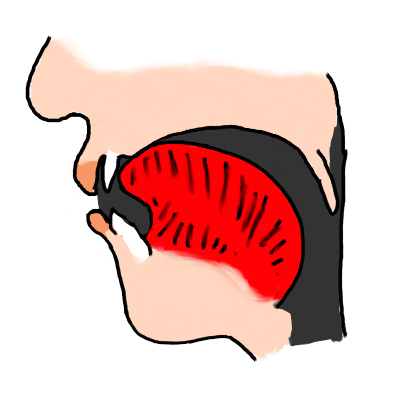 | The French 'l' is similar to the 'l' in English "with Lee". The tongue tip usually touches the back of the upper teeth. It is also a so-called "clear" l: in other words, you don't raise the back of your tongue as you pronounce the French 'l', as occurs in some cases in English. | |
| a |  | The French 'a' vowel is pronounced with the tongue far forward in the mouth and the mouth quite wide open, but not quite as open as for a typical English 'a' vowel. | |
| k |  | A French 'k' sound (often written "qu" or, as in English, "c") is generally pronounced in a similar way to the English 'k' sound of "skin", "scan" etc. In other words, it is not usually followed by a "strong burst of air" (aspiration) as in the 'k' sound of English "kit", "can" etc. If you are a native English speaker, repeat the word "cool" then "school" while holding your hand in front of your mouth. In the word "cool", you'll feel a stronger burst of air than in "school". In French, you always pronounce the 'k' sound as in English "school", without the strong burst of air. | |
| ɔ | 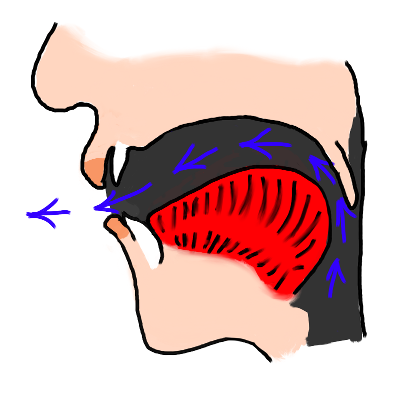 | To an English speaker, the French 'open o' vowel does not necessarily sound much like an 'o' vowel. In reality it is often much more similar to the "neutral" 'e' vowel of English "the". Hold the tongue in a position where you imagine the body of the tongue "slightly further back than the center of the mouth", with the lips slightly rounded. | |
| p | 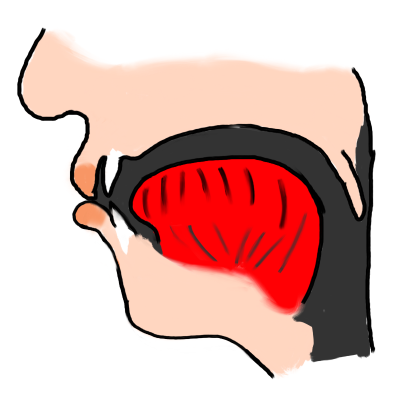 | A French 'p' is generally pronounced in a similar way to an English 'p' in "spit", "sport" etc. In other words, it is not usually followed by a "strong burst of air" (aspiration) as in the 'p' sound of English "pit", "port" etc. If you are a native English speaker, put your hand in front of your mouth while you say "port" then "sport"; you'll feel a stronger breath of air with the first of these words. When you pronounce a French 'p' sound, you do so as in the second of these words, so that you don't hear or feel the strong breath of air. | In this particular case, before a 'i' vowel, a French 'p' sound may actually be pronounced with some aspiration. |
| i |  | The French 'i' vowel is pronounced with the tongue almost as far forward and close to the roof of the mouth as it will go and with the lips spread. Aim to "tense" your lips for a moment as you pronounce it. | |
| n | 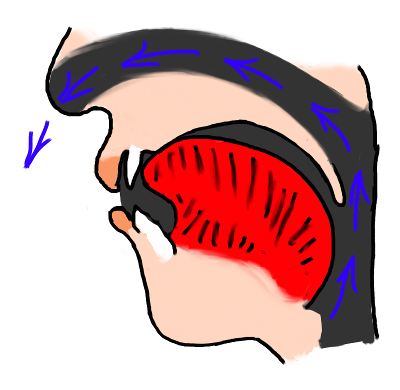 | The French 'n' sound is similar to the 'n' of English "tenth", i.e. pronounced with the tip of the tongue touching the upper teeth. | |
| ə | 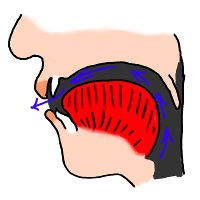 | The 'schwa' or 'neutral e' is pronounced with the tongue in a "central, relaxed" position and the mouth also in a 'half open, relaxed' position. Note that many French speakers actually tend to pronounce this vowel as a 'close eu' vowel (as occurs at the end of words ending in -euse), or at least with some rounding of the lips. | Even though the word ends in -e in the spelling, notice how in the pronunciation, this vowel isn't "fully" pronounced. Instead, the syllable before it receives the stress. |